
If you want to improve the appearance of a tooth, you may hear two possible treatment options: a veneer or crown.
Both can change how a tooth looks, but they are not interchangeable. A dentist does not usually choose between them based on appearance alone.
The condition of the tooth, amount of healthy structure remaining, reason for treatment, bite and function, existing dental work, and your cosmetic goals can all influence the recommendation.
That is why choosing a veneer or crown should begin with an evaluation rather than a general rule about which treatment is better.
Veneer or Crown: What Is the Difference?
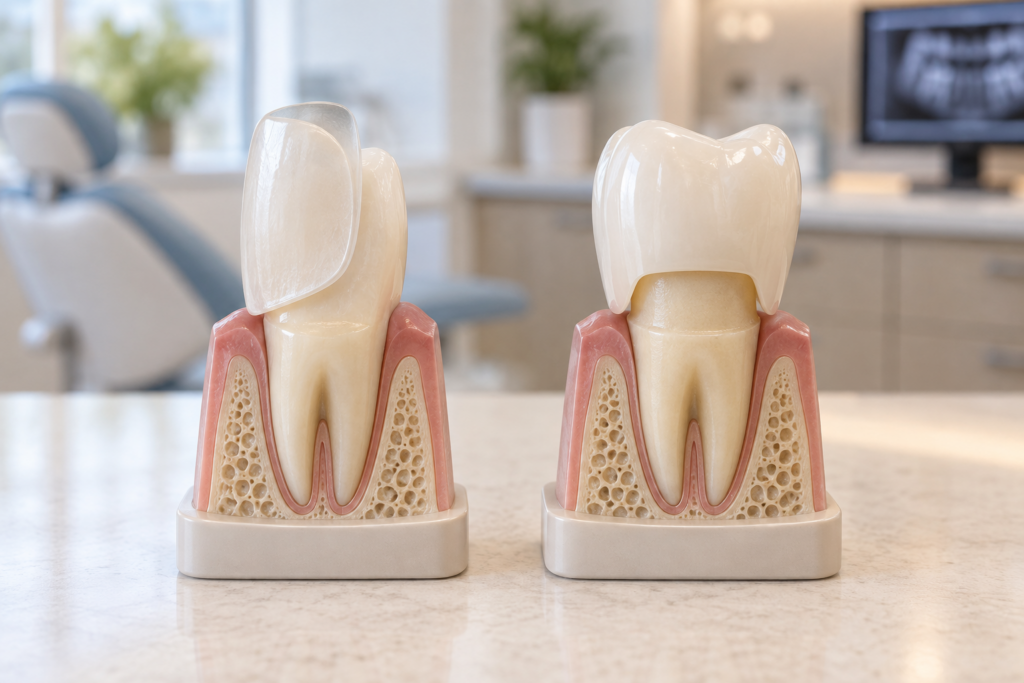
A veneer is a thin covering placed over the visible portion of a tooth and is primarily discussed when the treatment goal is cosmetic.
Veneers may be considered when an appropriate tooth has concerns involving color, shape, proportions, or another aspect of its visible appearance.
A crown provides more extensive coverage around a tooth.
Crowns may be considered when a tooth needs greater structural restoration or coverage in addition to an improvement in appearance.
The main distinction is not simply that one treatment is smaller and the other is larger. They serve different purposes.
A veneer may be considered when the tooth is structurally suitable and the main goal is cosmetic. A crown may make more sense when the tooth also has restorative needs that require more extensive coverage.
When May a Veneer Be Considered?
A veneer may be an option when the tooth is generally suitable for cosmetic treatment and the primary concern involves appearance.
Patients may want to address concerns such as:
- Tooth color
- Shape
- Proportions
- Small cosmetic irregularities
- How one tooth fits into the overall appearance of the smile
The dentist also looks beyond the individual tooth.
Adjacent teeth, the patient’s expectations, existing dental work, and the broader appearance of the smile can all influence the discussion.
For some patients, veneers may also be considered as part of a broader smile makeover rather than as an isolated treatment.
A veneer is not automatically appropriate simply because a patient wants to change how a tooth looks. The dentist still needs to determine whether the tooth is a suitable candidate.
When May a Crown Be More Appropriate?
A crown may be considered when a tooth needs more extensive restoration or coverage.
For example, the dentist may be more likely to discuss a crown when a tooth has substantial structural damage, a large existing restoration, or another condition that changes how much support the remaining tooth needs.
The purpose may involve both function and appearance.
A crown should not be viewed as simply a more aggressive version of a veneer. If the tooth has restorative needs, the recommendation is based on what the tooth requires rather than on which cosmetic option the patient prefers.
Likewise, not every damaged tooth automatically needs a crown. The appropriate treatment depends on the clinical findings.
How Do Tooth Condition and Remaining Structure Affect the Decision?
One of the most important questions is what the tooth looks like beneath the cosmetic concern.
A tooth with relatively healthy structure and a primarily aesthetic concern may be approached differently from a tooth that has been weakened by decay, trauma, previous treatment, or structural loss.
The dentist may evaluate:
- How much healthy tooth structure remains
- Existing fillings or other restorations
- Cracks or structural damage
- The condition of the surrounding tooth
- Bite and function
- The reason treatment is being considered
This is why two teeth that appear similar in a photograph may need different treatment.
A cosmetic concern can sometimes have an underlying restorative component that is not obvious from appearance alone.
If the tooth needs more substantial support or coverage, a veneer may not address the complete problem. If the structure is appropriate and the concern is primarily cosmetic, greater coverage may not be necessary.
The goal is to match the treatment to the tooth rather than forcing the tooth into a predetermined treatment plan.
Why Do Your Cosmetic Goals Matter?
Clinical findings are only part of the decision.
The dentist also needs to understand what you want to change.
You may be interested in a subtle adjustment to one tooth, a change in shape or color, or a more coordinated improvement across several visible teeth.
A consultation gives you an opportunity to explain those goals while learning what the teeth can reasonably support.
This is an important part of cosmetic dentistry. Treatment planning should consider both the health of the tooth and what you want the final smile to accomplish.
Your preferences matter, but they need to be considered alongside the condition and function of the teeth.
Crown vs. Veneer for Front Teeth
Patients often ask whether a veneer or crown is better for a front tooth because these teeth are especially visible when speaking and smiling.
Visibility alone does not determine the treatment.
A front tooth may be appropriate for a veneer when the concern is primarily cosmetic and the tooth has suitable structure. A crown may be considered when the same tooth needs greater restorative coverage.
The dentist may also consider existing dental work, bite forces, remaining healthy structure, and how the tooth should coordinate with the rest of the smile.
The location of the tooth matters, but it is still only one part of the evaluation.
Can a Dentist Recommend Neither One?
Yes.
A veneer or crown is not automatically necessary whenever a patient wants to change a tooth.
Sometimes another treatment may be more appropriate or more conservative based on the condition of the tooth and the patient’s goal.
For example, the dentist may find that a less extensive restorative option can address the concern. In another case, a different cosmetic approach may make more sense.
This is one reason it is helpful to begin with the problem you want to solve rather than with a specific procedure you have already chosen.
The consultation is meant to determine which options fit the tooth, not simply confirm a treatment decision made beforehand.
How Can Cosmetic and Restorative Needs Overlap?
Cosmetic and restorative dentistry are not always completely separate.
A tooth may look different because of an older restoration, structural damage, wear, or another underlying dental issue.
In those situations, improving appearance may also involve addressing the health or structure of the tooth.
Likewise, a restorative treatment can sometimes affect the appearance of a visible tooth.
A comprehensive approach allows the dentist to consider both sides of the decision at the same time.
For example, the discussion may include:
- What the tooth needs structurally
- What you want to change cosmetically
- Whether surrounding teeth should be considered
- How the tooth functions within your bite
- Existing dental work
- Whether another treatment option could accomplish the goal more conservatively
Considering these factors together can help keep the plan focused on the whole smile rather than on one isolated procedure.
What Questions Should You Ask During a Cosmetic Consultation?
If you are deciding between a veneer and crown, ask why the dentist is recommending one treatment rather than another.
Useful questions include:
- What is the current condition of this tooth?
- How much healthy tooth structure remains?
- Is the primary goal cosmetic, restorative, or both?
- Why are you recommending a veneer or crown?
- Are there other reasonable treatment options?
- How will this tooth fit with the rest of my smile?
- Does my bite affect the recommendation?
- Is there existing dental work that changes the treatment plan?
You do not need to choose a treatment simply because you have seen it online or know someone who had the same procedure.
The same cosmetic concern can require a different approach when the underlying tooth condition is different.
A clear explanation should help you understand not only what is being recommended, but also why.
Veneer or Crown: The Right Choice Depends on the Tooth
Veneers and crowns can both play a role in improving a smile, but they are designed for different clinical situations.
A veneer may be appropriate when the main concern is cosmetic and the tooth has suitable structure. A crown may be considered when the tooth needs greater coverage or restorative support. In some situations, neither treatment may be the most appropriate choice.
We consider the condition of the tooth, remaining healthy structure, function, existing dental work, and your cosmetic goals before recommending treatment.
That individualized approach helps keep the treatment plan focused on both the health of the tooth and the appearance you want to achieve.
If you are unsure whether a veneer, crown, or another treatment may be appropriate for your smile, contact us to schedule a consultation and discuss your options.